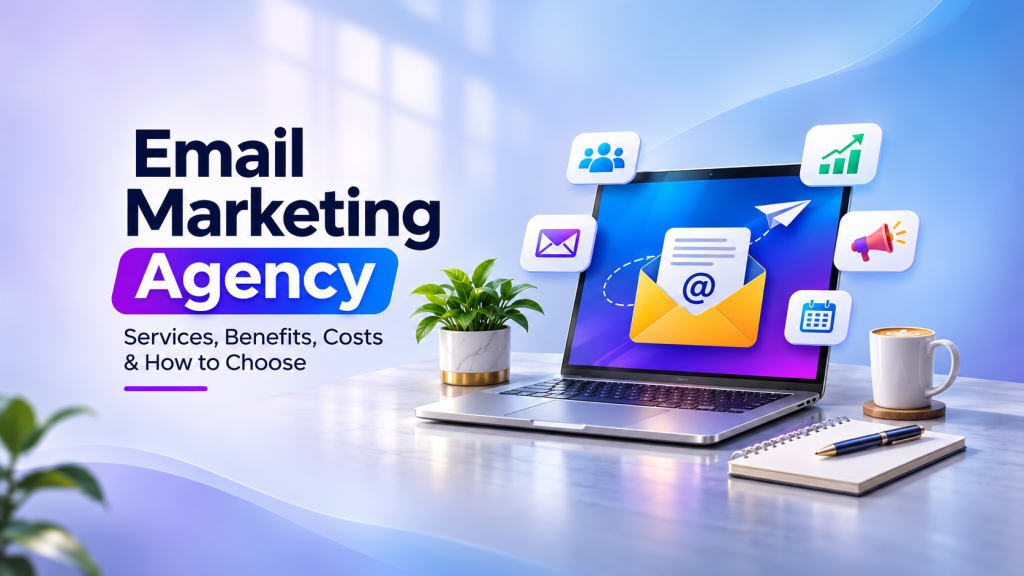

An email marketing agency helps businesses plan, write, design and manage email campaigns. Its services include newsletter creation, customer list management, automated emails, campaign testing and performance reporting. Businesses can hire an agency to promote products, maintain customer relationships and encourage repeat purchases without managing every email themselves.
Some companies need a monthly newsletter, while others require regular product campaigns and automatic customer messages. The right service depends on your business goals, customer list and marketing budget.
This guide explains email marketing services, monthly packages, campaign costs, popular email platforms and how to choose the right agency.
What Is an Email Marketing Agency?
An email marketing agency is a company that manages email communication between a business and its audience. Unlike a company that only provides email software, an agency offers professional support with campaign planning, content preparation and ongoing management.
Businesses can choose from three common service arrangements:
- Full-service email marketing: The agency manages most parts of the email marketing process.
- Individual email marketing services: The business hires professionals for specific tasks, such as writing or design.
- Email marketing consulting: A specialist reviews existing campaigns and recommends improvements.
The business remains responsible for providing accurate product information, approving important messages and following applicable marketing laws.
What Services Does an Email Marketing Agency Offer?
Professional email marketing services cover several tasks that help businesses prepare and manage customer communication.
Email Marketing Strategy
An email marketing strategy determines what your business wants to achieve through email. It identifies customer needs, suitable offers, communication goals and marketing priorities. The strategy also helps decide which campaigns deserve the largest share of your marketing budget.
Email Campaign Management Services
Campaign management handles the daily work involved in preparing and sending emails. The agency manages campaign dates, internal approvals, sending schedules and final checks. This helps businesses coordinate their email activities with product launches, seasonal offers and company announcements.
Email Copywriting Services
Email copywriting focuses on the words customers read in their inboxes. It includes subject lines, headlines, product messages and button text. The writing should explain the purpose of the message without confusing the reader or making misleading promises. Businesses can also use Fyzat’s creative content writing services to prepare website articles and promotional content that supports their email campaigns.
Email Template Design Services
Email templates provide a reusable layout for newsletters and promotional messages. A designer selects suitable colours, text sizes, image placement and button styles. The finished template should remain readable across different screen sizes and email applications. Professional graphic design services can help businesses prepare branded banners, product graphics and other email visuals.
Email List Management
Email list management keeps subscriber information organized and accurate. It involves managing new subscriptions, updating contact details, handling unsubscribe requests and removing addresses that repeatedly fail to receive messages. A clean subscriber list helps reduce unnecessary sending costs and delivery problems.
Customer Segmentation
Customer segmentation means dividing subscribers into smaller groups based on relevant information. An online store may separate first-time buyers from regular customers. A training company may organize subscribers according to the courses they are interested in. Each group can then receive messages that match its needs rather than receiving every business announcement.
Email Marketing Automation Services
Email automation sends messages automatically when a planned action or event takes place. An agency can prepare connected messages, set delivery times and decide when an automatic email series should stop. This service is useful for businesses that receive regular subscriptions, purchases or customer requests.
Email Campaign Testing
Testing helps businesses identify which parts of an email receive better customer responses. An agency may compare two subject lines, button styles or promotional messages while keeping other campaign elements unchanged. The results can guide future campaigns without relying entirely on assumptions.
Email Performance Reporting
Performance reports help business owners understand what happened after a campaign was sent. Reports can include email delivery, link clicks, customer actions, purchases and unsubscribe activity. A useful report should explain the results and recommend practical changes for the next campaign.
Types of Email Marketing Campaigns
Different email campaigns serve different stages of the customer relationship.
| Email Campaign Type | Main Purpose |
|---|---|
| Welcome email | Introduce the business to a new subscriber |
| Promotional email | Present a specific product, discount or offer |
| Newsletter | Share regular news and helpful information |
| Product launch email | Announce a new product or service |
| Abandoned cart email | Remind eligible shoppers about unfinished purchases |
| Post-purchase email | Provide useful information after an order |
| Re-engagement email | Reconnect with inactive subscribers |
| Customer feedback email | Request feedback after a purchase or service |
| Seasonal email | Promote offers linked to holidays or seasonal needs |
Choose campaigns based on the customer’s relationship with your business rather than sending every type of email to everyone.
Marketing Emails vs Transactional Emails
Marketing emails promote a business, product or service. Transactional emails provide information about an existing customer action. An order confirmation, payment receipt or password reset message is normally transactional. A product discount or seasonal promotion is normally marketing.
Businesses should manage these messages separately where appropriate. Adding promotional content to a transactional email may change which legal requirements apply.
How Does an Email Marketing Agency Improve Email Delivery?
Email deliverability refers to the ability of an email to reach a recipient’s inbox rather than the spam folder. Even a well-written campaign may perform poorly if receiving email services block it or place it in spam. Professional email deliverability services can include reviewing sending settings, checking rejected messages and monitoring complaints.
Important Email Sending Settings
Three common settings help receiving email services check whether a message comes from an authorized sender.
| Setting | What It Does |
|---|---|
| SPF | Identifies systems allowed to send email for your domain |
| DKIM | Adds a digital signature that helps verify a message |
| DMARC | Helps email providers handle messages that fail identity checks |
These settings help protect your business domain from unauthorized use and support reliable email delivery. Google requires senders to personal Gmail accounts to meet authentication and other sending requirements. Bulk senders that reach Google’s applicable threshold of around 5,000 messages per day must meet additional requirements, including SPF, DKIM, DMARC and one-click unsubscribe for relevant marketing messages. Read the official Google email sender guidelines before preparing large campaigns.
What Causes Marketing Emails to Go to Spam?
Common causes include:
- Incorrect email sending settings
- High numbers of invalid email addresses
- Frequent spam complaints
- Unwanted marketing messages
- Misleading sender information
- Sudden increases in sending volume
An agency should investigate delivery problems before increasing the number of emails sent. No email marketing company can guarantee that every message will reach the recipient’s inbox.
What Are the Benefits of Hiring an Email Marketing Agency?
Hiring professional email marketing services can provide several advantages for businesses without a dedicated marketing team.
Access Different Professional Skills
A single employee may not have experience in writing, design, email software and campaign analysis. An agency can provide access to different specialists without requiring a business to employ a separate person for every task.
Reduce Pressure on Internal Teams
Preparing weekly campaigns alongside customer service and sales responsibilities can become difficult. Outside support allows employees to focus on their main responsibilities while the agency handles the agreed marketing work.
Support Customer Retention
Customer retention means encouraging existing customers to continue buying from your business. Useful reminders, product advice and relevant updates can give customers reasons to return instead of looking for another provider.
Reduce Dependence on Social Media
Social media platforms control how and when followers see business content. A properly managed subscriber list gives a business another way to communicate with people who want to receive its messages.
Make Better Use of Marketing Resources
Professional management can help identify unnecessary campaigns, unused software features and time-consuming manual tasks. Removing these expenses allows a business to focus more of its budget on activities that serve a useful purpose.
Email Marketing Packages for Different Businesses
Email marketing packages usually provide an agreed amount of monthly work. The following sample packages show how different service levels can meet different business requirements.
| Monthly Service | Basic | Business | Advanced |
|---|---|---|---|
| Email campaigns | 2 | 4 | 8 |
| Email copywriting | Included | Included | Included |
| Email template design | Standard | Custom | Custom |
| Subscriber management | Basic | Regular | Extended |
| Customer grouping | Limited | Included | Detailed |
| Automated emails | Separate | Selected | Extended |
| Campaign testing | Basic | Regular | Extended |
| Performance report | Monthly | Monthly | Twice monthly |
These are illustrative package structures, not official Fyzat packages.
Basic Email Marketing Package
A basic package suits small businesses that send occasional newsletters, company updates or seasonal promotions. It can also suit companies that are beginning to build a subscriber list.
Business Email Marketing Package
A business package suits companies with regular offers, new products and an established customer base. It provides more room for weekly campaigns and communication with different subscriber groups.
Advanced Email Marketing Package
An advanced package suits online retailers, larger companies and businesses that manage several customer communication activities at once. These companies may need detailed reports, multiple automatic email sequences and ongoing campaign testing. Select a package based on your actual communication needs rather than simply choosing the one with the highest number of emails.
How Much Does an Email Marketing Agency Cost?
| Marketing Activity | Share | Cost |
|---|---|---|
| Email marketing software | 15% | $150 |
| Email writing and design | 25% | $250 |
| Campaign management | 30% | $300 |
| Automation setup and management | 20% | $200 |
| Reporting and testing | 10% | $100 |
| Total Monthly Budget | 100% | $1,000 |
Budget planning illustration only, not actual Fyzat pricing or an industry average.
Common Email Marketing Pricing Models
| Pricing Model | Suitable For |
|---|---|
| Monthly management fee | Businesses requiring regular campaign support |
| Per-campaign pricing | Occasional promotions and newsletters |
| One-time setup fee | New email accounts, templates or automatic messages |
| Hourly consulting | Businesses needing professional advice |
| Custom pricing | Larger or more complex projects |
What Affects the Cost of Email Marketing?
- Campaign volume: Preparing eight monthly campaigns generally requires more work than preparing two.
- Subscriber list size: Email platforms may charge according to contact numbers or sending limits.
- Design requirements: Original graphics and custom layouts can increase production costs.
- Automatic email sequences: Connected messages require additional setup and testing.
- Software connections: Linking an email platform with an online store or customer management system may require specialist assistance.
- Reporting requirements: Detailed sales reports and regular meetings may increase management fees.
Sample Monthly Email Marketing Budget
A business with a monthly budget of $1,000 could divide its spending as follows.
| Marketing Activity | Monthly Budget |
|---|---|
| Email marketing software | $150 |
| Email writing and design | $250 |
| Campaign management | $300 |
| Automation management | $200 |
| Testing and reporting | $100 |
| Total | $1,000 |
All amounts are in US dollars. This is a budget planning illustration, not an industry average or an actual Fyzat quotation. Before approving a proposal, check whether the agency fee includes software subscriptions, additional campaigns and future template changes.
How Does Email Marketing Automation Work?
Email marketing automation uses planned rules to send messages at suitable times. Once the business approves the messages and sending conditions, the software handles the regular delivery process.
Welcome Email Sequence
A welcome sequence can introduce new subscribers to a business over several days.
| Sending Time | Email Content | Purpose |
|---|---|---|
| Immediately after signup | Welcome message | Explain what subscribers will receive |
| Day 3 | Helpful product or service guide | Provide useful information |
| Day 7 | Relevant product introduction | Encourage further interest |
This schedule suits subscribers who have agreed to receive marketing messages. The timing can change based on the business and its audience.
Abandoned Cart Email Sequence
Online stores can use eligible cart reminders to help shoppers return to an unfinished purchase. A suitable sequence may include an initial reminder, product information and a later message addressing common purchase questions.
Stop the sequence when the customer completes the purchase, unsubscribes or otherwise becomes ineligible to receive it. Businesses must check whether these messages are permitted under the marketing rules that apply to their customers.
Post-Purchase Email Sequence
A post-purchase sequence can provide product instructions, care advice and permitted follow-up messages. It can also help customers understand how to use a product correctly, reducing unnecessary questions to the customer service team.
How to Build an Email Subscriber List
A useful email list contains people who have a genuine interest in your business and can lawfully receive the intended messages. Start by giving customers a clear reason to subscribe.
Suitable ways to collect subscribers include:
- Website newsletter signup forms
- Voluntary signup options during checkout
- Helpful guides and downloadable resources
- Event registrations with appropriate marketing choices
- Product availability notifications
- Social media promotions that direct people to a signup page
Explain what subscribers will receive and how their information will be used. Keep records of how and when customers subscribed. Collect only the information needed for the intended purpose. Fyzat’s website design and development services can help businesses create clear signup forms and suitable website pages.
What Does a Monthly Email Marketing Plan Look Like?
A monthly email marketing plan helps businesses prepare campaigns before important selling periods. It should contain a balance of educational, promotional and customer support content. The following four-week schedule suits an online clothing business.
| Week | Email Subject | Main Purpose |
|---|---|---|
| Week 1 | New clothing collection | Introduce available products |
| Week 2 | How to care for your clothes | Provide useful customer advice |
| Week 3 | Clothing guide for the coming season | Support purchase decisions |
| Week 4 | Seasonal product promotion | Encourage customers to shop |
Automatic welcome and post-purchase messages can run separately from this monthly schedule. A useful calendar should also record the person responsible for preparing each message, its approval deadline and the intended subscriber group.
Email Marketing Services for Different Industries
Customer needs vary between industries. A suitable email marketing strategy should reflect how customers research, purchase and use products or services.
eCommerce Email Marketing Agency Services
Online retailers can use email marketing to support the entire shopping process. Campaigns may focus on product availability, size guides, new collections and products that customers may need to buy again. An eCommerce email marketing agency can also help organize product-related messages around shopping activity.
Email Marketing for Small Businesses
Small businesses may only need a limited number of regular emails. A local shop can send stock updates and upcoming event information. A repair business may share maintenance advice and appointment availability. A smaller plan helps business owners manage expenses while building a relationship with interested customers.
B2B Email Marketing Agency Services
Business-to-business companies often have longer buying processes than online retailers. Their customers may need technical documents, service comparisons, project information or several discussions before making a purchase. Useful B2B emails can support these decisions by sharing relevant information with suitable business contacts.
Email Marketing for Educational Organizations
Schools, colleges and training companies can organize communication around academic schedules. Emails may explain course requirements, registration deadlines, class dates and available study options. Marketing messages should remain separate from essential student communication where appropriate.
Email Marketing for Local Service Businesses
Local service companies can send messages based on genuine customer needs within their service areas. A heating company may share winter maintenance advice, while a cleaning business may provide seasonal cleaning information. Companies should avoid sending offers for services that customers cannot receive in their location.
Email Marketing for Professional Service Providers
Accountants, consultants and other professionals can use email newsletters to share general industry updates and explain common client questions. Their messages should follow professional advertising rules and avoid sharing confidential client information.
Best Email Marketing Platforms for Businesses
An email marketing platform provides the tools needed to prepare, send and manage emails. The best choice depends on your subscriber list, website, required features and budget.
| Email Platform | Best Suited For | Main Strength |
|---|---|---|
| Mailchimp | Small businesses and newsletters | General campaign management |
| Klaviyo | Online stores | Shopping-related customer messages |
| HubSpot | Sales and marketing teams | Managing customer information |
| Brevo | Small and growing businesses | Email campaigns and customer communication |
| ActiveCampaign | Businesses needing detailed automatic messages | Connected email sequences |
How to Choose Email Marketing Software
Before selecting a platform, check:
- Monthly subscription cost
- Number of contacts supported
- Email sending limits
- Available templates
- Connections with your website
- Automatic messaging features
- Customer support
- Data export options
Software features, prices and account limits can change. Review the provider’s current plans before purchasing a subscription.
What Email Marketing Rules Should Businesses Follow?
Email marketing laws protect recipients from unwanted messages and misleading business communication. The requirements vary between countries, recipient types and the purpose of the email.
United States Email Marketing Rules
The CAN-SPAM Act covers commercial email messages in the United States. Businesses must use accurate sender information, avoid misleading subject lines, include a valid postal address and provide a suitable unsubscribe method. The law also includes requirements for handling opt-out requests. Read the FTC’s CAN-SPAM compliance guide for further information.
United Kingdom Email Marketing Rules
Businesses sending marketing emails in the United Kingdom must consider the Privacy and Electronic Communications Regulations (PECR) and applicable data protection requirements. Marketing emails to individual subscribers generally require consent unless a permitted exception applies. Different rules may apply to corporate subscribers. The ICO’s electronic mail marketing guidance explains these requirements.
European Union Email Marketing Rules
Businesses targeting customers in the European Union must consider the General Data Protection Regulation (GDPR) and applicable national electronic marketing laws. Requirements may vary between member countries and types of recipients.
Basic Good Practices for Marketing Emails
Regardless of your market, responsible email marketing should include:
- Clear information about the sender
- Accurate and honest subject lines
- Appropriate permission or another lawful basis where permitted
- A working unsubscribe option
- Safe handling of customer information
- Records of subscriber preferences
Hiring an outside agency does not remove the business’s responsibility to follow applicable marketing rules.
How to Measure Email Marketing Performance and ROI
Email marketing reports should show whether campaigns support meaningful business results. Opening an email is only one customer action. Businesses also need to understand which messages receive clicks, enquiries and purchases.
Important Email Marketing Metrics
| Measurement | What It Shows |
|---|---|
| Delivery rate | Percentage of sent emails accepted by receiving mail systems |
| Open rate | Estimated percentage of delivered emails opened |
| Click-through rate | Percentage of delivered emails receiving unique recipient clicks |
| Conversion rate | Percentage of the defined audience completing a desired action |
| Bounce rate | Percentage of emails that failed to be delivered |
| Unsubscribe rate | Percentage of delivered emails resulting in unsubscribe actions |
| Attributed revenue | Sales connected to campaigns by the reporting system |
| Marketing ROI | Estimated financial return after marketing expenses |
Email privacy features can affect open rate measurements. Automated security checks can also affect reported clicks. Review these measurements alongside genuine customer replies, purchases and other meaningful actions.
Sample Email Marketing Performance Report
| Performance Metric | Sample Result |
|---|---|
| Emails sent | 10,000 |
| Emails delivered | 9,800 |
| Unique link clickers | 490 |
| Attributed purchases | 50 |
| Unsubscribes | 20 |
| Attributed sales revenue | $3,500 |
| Gross profit before marketing costs | $1,750 |
| Total marketing cost | $1,000 |
These figures are hypothetical and demonstrate how businesses can calculate campaign performance.
How to Calculate Email Delivery Rate
Delivery Rate = Delivered Emails ÷ Sent Emails × 100 9,800 ÷ 10,000 × 100 = 98% This means receiving mail systems accepted 98% of the sent messages. It does not confirm that every accepted message reached the inbox.
How to Calculate Email Click-Through Rate
Click-Through Rate = Unique Link Clickers ÷ Delivered Emails × 100 490 ÷ 9,800 × 100 = 5% Use the same reporting method when comparing results from different campaigns.
How to Calculate Email Marketing ROI
Return on investment (ROI) helps businesses estimate the financial value of their marketing expenses. Marketing ROI = (Attributed Gross Profit − Marketing Cost) ÷ Marketing Cost × 100 ($1,750 − $1,000) ÷ $1,000 × 100 = 75%
In this illustration, the estimated return after marketing costs is $750. The campaign also records $3.50 in attributed sales revenue for every $1 spent on marketing. Revenue and profit are different measurements. Attributed sales also do not necessarily prove that the campaign caused every recorded purchase.
If email campaigns bring people to your website but generate few enquiries, read Fyzat’s guide on why your website gets traffic but no leads to understand other problems that may affect customer actions.
How Long Does Email Marketing Take to Show Results?
An existing subscriber list may generate clicks or enquiries shortly after a campaign begins. A new business without subscribers may need considerably more time. A typical email marketing project can follow this working schedule.
| Period | Main Activities |
|---|---|
| Week 1 | Account review and business research |
| Week 2 | Sending settings and template preparation |
| Weeks 3–4 | Initial campaigns and automatic message setup |
| Month 2 | Campaign testing and customer response analysis |
| Month 3 | Review marketing results and spending |
| Month 4 onward | Continued improvements based on collected information |
This is a project planning schedule, not a guaranteed timeline for sales or revenue growth.
Email Marketing Agency vs In-House Email Marketing
Businesses can hire an outside agency or manage email marketing through their own employees. Each option has different costs and responsibilities.
| Factor | Email Marketing Agency | In-House Marketing |
|---|---|---|
| Main expense | Agency fees | Employee salaries and resources |
| Professional skills | Access to different specialists | Depends on existing staff |
| Daily control | Shared between business and agency | Managed internally |
| Work capacity | Depends on the service agreement | Depends on available employees |
| Business knowledge | Requires clear information from the client | Direct knowledge of operations |
| Staff training | Less internal training may be required | Business manages employee training |
A business does not always need to choose one option completely. An internal employee can manage customer information while an outside agency prepares email designs, writing or specialist campaign work.
Common Email Marketing Mistakes to Avoid
Small mistakes can affect customer confidence and create unnecessary expenses.
Buying Email Address Lists
Purchased lists may contain outdated addresses, unsuitable contacts and people who have no interest in your business. These lists can increase complaints and may create legal and delivery problems.
Using a No-Reply Email Address
Customers may want to ask a question after reading a message. Where practical, use a monitored email address so recipients have a suitable way to respond.
Sending Expired Offers
Check campaign dates against current product availability and promotional conditions. Customers should not receive an offer after the business has stopped providing it.
Using Too Many Promotional Messages
Subscribers may lose interest when every email asks them to buy something. Balance promotional content with useful product advice and relevant business information.
Leaving Automatic Emails Unchecked
An automatic sequence may continue using old prices, discontinued products or incorrect contact information. Review these messages whenever important business details change.
Sending Emails Without Final Checks
Test every important link, button and image before sending a campaign. Send a preview to an internal account and check how the message appears on a mobile device.
How to Choose the Right Email Marketing Agency
Choosing a suitable email marketing company requires checking its experience, service agreement and working methods.
Review Relevant Email Marketing Experience
Ask to see previous campaigns or permitted samples of completed work. Check whether the agency has experience with your type of business, intended audience and email platform.
Confirm Monthly Deliverables
Request a written description of the work included in the quotation. The agreement should explain the number of campaigns, templates, reports and automatic email sequences the agency will provide.
Check Email Delivery Knowledge
Ask how the agency manages sending settings, invalid addresses and spam complaints. A provider should be able to explain these matters in simple language.
Understand Account and Data Ownership
Your business should retain control of its email marketing account, subscriber information and sending domain. Check whether you can export customer information and completed marketing materials if you change providers.
Review Customer Data Protection
Find out who can access subscriber information and how the agency protects it. The agreement should explain how customer data is stored, used and returned or deleted when the service ends.
Check Reporting and Contract Terms
Confirm the reporting schedule, payment dates, extra charges, revision limits and cancellation conditions. Avoid agreements that promise guaranteed sales without explaining how results will be measured.
How Fyzat Can Support Your Email Marketing Strategy
Successful email campaigns often depend on the quality of the website, content and marketing materials customers receive. Fyzat provides related digital marketing services that can support these requirements.
Attract Potential Subscribers Through SEO
Fyzat’s organic SEO services help businesses reach people searching for relevant products, services and information. Interested website visitors can choose to join a mailing list and receive future updates.
Prepare Useful Website Content
Clear product pages, service descriptions and helpful articles give businesses useful material to share through newsletters. Professional content can also help answer questions that customers may have after receiving an email.
Create Branded Marketing Materials
Consistent promotional graphics help maintain a familiar business appearance across email, websites and social media. Suitable designs can support product announcements, seasonal offers and business updates.
Improve Website Enquiry and Purchase Processes
Businesses receiving visitors through email campaigns need suitable pages where customers can review information and complete their intended actions. Website improvements can help reduce problems between clicking an email link and submitting an enquiry or making a purchase. Visit Fyzat’s digital marketing services page to review available support and discuss the requirements of your project.
Final Thoughts
Hiring an email marketing agency can help businesses manage customer communication without adding unnecessary pressure to their internal teams. The right service depends on the number of customers you need to contact, the information they want to receive and the resources available to your business.
Start with a manageable campaign plan, maintain accurate subscriber information and review meaningful results before increasing your marketing budget. A well-planned email campaign should give customers a useful reason to read, respond or return to your business.
If you need professional website development, content writing, graphic design or wider marketing support, contact Fyzat to discuss your business requirements.
FAQs
An email marketing agency is a company that helps businesses plan, write, design, send, and manage marketing emails. It may also provide customer list management, automation, and campaign reports.
Common services include email campaign management, email copywriting, newsletter design, customer grouping, automated emails, campaign testing, and performance reporting.
Pricing depends on the number of campaigns, subscriber list size, design needs, and services included. Agencies may charge monthly fees, project prices, or fees for individual campaigns.
An agency can be useful when a business needs regular email campaigns but lacks the time or staff to manage them. Whether it is worth the cost depends on the services provided and the value they bring to the business.
The best agency for a small business is one that understands its needs, offers clear pricing, communicates well, and provides suitable services within its budget.
No agency can guarantee a certain number of sales from every campaign. A reliable company should explain realistic goals, review campaign performance, and recommend suitable improvements.