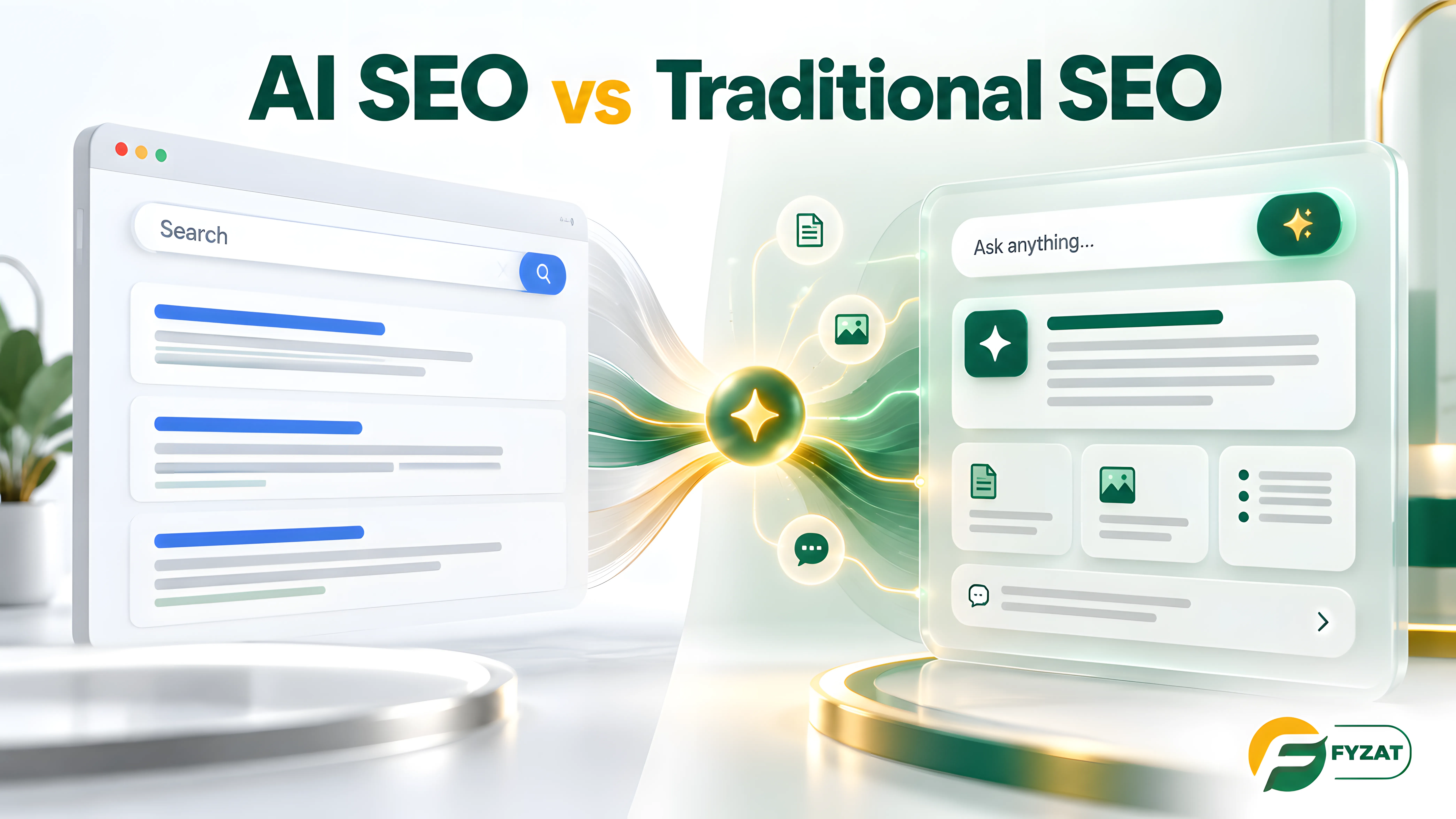
AI SEO vs Traditional SEO: What Businesses Need to Know in 2026

Home / SEO / AI SEO vs Traditional SEO: What Businesses Need to Know in 2026

AI SEO vs Traditional SEO: What Businesses Need to Know in 2026
Updated Aug 12, 2026
7 min read
SEO

Your website is getting visitors. Google Analytics shows traffic, Search Console shows clicks. People are landing on your pages, but there is one problem: they are not becoming leads.

More traffic does not automatically mean more customers. If 10,000 people visit a website but almost none of them enquire, book, call, or buy, the business may have a conversion problem rather than a traffic problem.

Here are 12 common reasons your website gets traffic but no leads.

Attracting the Wrong Visitors

Not all website traffic has the same value. Imagine you sell SEO services to businesses.

A blog about ’’fun things to search on Google’’ might attract thousands of visitors, but most of those visitors are not looking for an SEO agency. A smaller number of visitors searching for ‘’SEO services for small business’’ may be much more valuable. This is why traffic quality matters.

Problem 1: Your keywords have the wrong intent

Check what people want when they search each keyword. A keyword can have:

Then decide whether each page should be: kept, improved, merged, redirected and removed.

Problem 2: Your content targets the wrong audience

Your traffic may be relevant to the general subject but irrelevant to your ideal customer. That means:

Page Does Not Match What Visitors Expected

A search result creates an expectation. If your title says: ‘’Affordable Web Design Services for Small Businesses’’, but the landing page mainly talks about branding, visitors may leave.

Problem 3: Search intent and landing page do not match

The page needs to deliver what the search result promised. A service query should usually lead to a strong service page. A how-to query should lead to useful instructions and a comparison query should provide a clear comparison. Match the page to the visitor’s purpose.

Problem 4: Your value proposition is unclear

Visitors should quickly understand: What do you offer? Who is it for? Why should they care? What should they do next?

Do not make visitors read half the page to understand your business.

Website Gives Visitors, No Strong Reason to Act

A visitor may like your page and still leave. Why? Because reading and taking action are different things.

Problem 5: Your CTA is weak or hidden

A call to action tells visitors what to do next. Avoid making every CTA vague. ‘’Learn More’’ can be useful in some places, but someone ready to contact you may need a clearer next step. Place CTAs where they make sense throughout longer pages.
Examples include:

Problem 6: The offer is not compelling

‘’Contact us’’ alone may not give a visitor enough motivation. Explain what happens after they contact you. For example: Request a Free SEO Consultation. Or Tell us about your website and goals. Our team will review your needs and discuss suitable next steps. Now the user understands the value and process.

Visitors Do Not Trust Your Business

People hesitate when they do not know whether a company is credible. This is especially important for professional services.

Problem 7: Your website lacks trust signals

Do not use fake testimonials or invented results. Real evidence is stronger. Useful trust signals may include:

Problem 8: You make claims without proof

Sometimes business make claims like ‘’Best SEO company’’, ‘’Guaranteed results’’, ‘’Number one agency.’’ These claims are weak without evidence. Show what you actually did.

For example:

Specific evidence is more convincing than exaggerated claims.

User Experience Creates Friction

Sometimes the offer is good, but the website makes taking action difficult.

Problem 9: Your website is slow, confusing or poor on mobile

Check your website on a real phone. Google recommends providing a strong overall page experience, including good mobile presentation, Core Web Vitals, secure delivery, and clear access to the main content.

Better UX is not only about SEO. It can directly affect whether a visitor stays and converts.

Problem 10: Your form asks for too much

Imagine someone wants a simple quote. Then the form asks for: Name, Email, Phone, Company, Job title, Company size, Revenue, Full address, Budget, Industry, Project type, Timeline, Long message. But you should ask only for information you genuinely need at that stage. You can collect more details later.

Not Measuring or Improving Conversion

You cannot improve what you do not understand.

Problem 11: You are measuring traffic instead of conversions

Traffic is useful, but it is not the final business goal. Track meaningful actions. Depending on the business, these may include:

Then identify which pages and channels produce them. A page with 300 visits and 20 qualified leads may be more valuable than a blog with 10,000 visits and zero leads.

Problem 12: You never test or improve your pages

Your first landing page does not need to be your final landing page. Use real data to improve it. You may test:

Do not randomly change everything at once. Identify the biggest problem, make a meaningful improvement, and measure the result.

Final Words

Traffic is valuable only when it supports your goals. If your website gets traffic but no leads, do not immediately assume you need more visitors.

First ask yourself: Are we attracting the right people? Is our offer clear? Do visitors trust us? Fixing those issues can make your existing traffic far more valuable.

Getting Traffic but Not Enough Enquiries? Contact Fyzat to discuss how your website can turn more qualified visitors into leads.

Frequently Asked Questions

Why is my website getting traffic but no leads?

Common causes include irrelevant traffic, poor search-intent matching, weak CTAs, unclear offers, low trust, poor mobile UX, complicated forms, and incorrect conversion tracking.

Not necessarily. Traffic quality and conversion performance matter. A smaller qualified audience can generate more business than a large irrelevant audience.

Review the search queries, landing pages, traffic sources, visitor behaviour, locations where relevant, and conversions. Determine whether visitors match the people likely to need your service.

A conversion is a meaningful action you want a visitor to complete, such as submitting a form, calling, booking a consultation, requesting a quote, registering, or purchasing.

There is no single good rate for every website. It varies by industry, traffic source, offer, device, business model, and conversion type. Compare performance against your own historical data and relevant business benchmarks.

Yes. SEO can attract potential customers when your keyword targeting, content, service pages, search intent, and conversion journey work together.

The keywords may be too informational, the page may not match user intent, the offer may be unclear, or the visitor may not have enough trust or motivation to take the next step.

Make the action specific and easy to understand. Explain what users get and what happens next. Place the CTA naturally at important decision points.

If unnecessary fields are creating friction, yes. Ask for the information needed to start the conversation and collect additional details later when appropriate.

Usually both. SEO can help attract qualified visitors, while conversion optimization helps turn more of those visitors into meaningful actions.

On this page

Is your SEO Strategy Ready for AI?

Get a comprehensive organic search audit from our specialists to identify gaps and growth opportunities.

MD Rakib

WRITTEN BY

MD Rakib

Author at Fyzat. Stay tuned for more informative articles and updates from this author.

Scroll to Top