Why Your Website Gets Traffic but No Leads: 12 Problems to Fix

Home / SEO / Why Your Website Gets Traffic but No Leads: 12 Problems to Fix

Why Your Website Gets Traffic but No Leads: 12 Problems to Fix

Updated Aug 12, 2026
11 min read
SEO

Getting website traffic but no leads can be frustrating. Google Analytics may show visitors, while Search Console reports impressions and clicks, but few people enquire, call, book, or buy.

This does not always mean you need more traffic. The real problem may be traffic quality, unclear messaging, weak calls to action, low trust, poor user experience, or inaccurate tracking.

The good news is that these problems can often be found and improved. Here are 12 common reasons your website attracts visitors but does not turn enough of them into leads.

Quick answer

High visitor numbers do not always produce enquiries or sales. If you have website traffic but no leads, problems with search intent, messaging, CTAs, trust, user experience, forms, or tracking may be responsible. This guide explores 12 common issues and explains how to improve the journey from qualified visitor to valuable enquiry.

Why You Get Website Traffic but No Leads

Website traffic is only useful when it supports a business goal. A large audience may look impressive, but visitor numbers alone do not show whether the right people are finding your website.

For example, a blog post with 10,000 visits and no qualified enquiries may provide less business value than a service page with 300 visits and 20 qualified leads. The smaller page reaches fewer people, but those visitors have a stronger reason to contact the business.

To understand why your traffic is not converting, start with the audience arriving on your website.

You Are Attracting the Wrong Visitors

Not all website traffic has the same value. A person looking for general information may enjoy your content but have no interest in buying your service.

Imagine that you sell SEO services to businesses. A blog about fun things to search on Google could attract many visitors, but most of them are unlikely to need an SEO agency. A smaller group searching for SEO services for small businesses may be much more valuable.

Problem 1: Your Keywords Have the Wrong Intent

A keyword may look relevant while attracting the wrong type of visitor. Before targeting it, consider what the searcher wants to achieve.

Common types of search intent include:

Informational content can build awareness and trust. However, a lead-generation strategy also needs commercial, comparison, problem-aware, and transactional searches connected to the services the business provides.

Review the search queries bringing people to your website. Ask whether those searches come from potential customers or from people who only want general information.

Problem 2: Your Content Targets the Wrong Audience

Your content may relate to your industry without speaking to the people most likely to need your services.

Define your ideal customer clearly:

Use these answers to guide your service pages, landing pages, articles, and calls to action. The goal is not to attract everyone. It is to attract people who are a good match for your business.

The Page Does Not Match What Visitors Expected

A search result creates an expectation. The page title and description tell users what they should find after clicking.

If a result promises affordable web design services for small businesses but the landing page mainly discusses brand identity, visitors may leave because the page does not answer their immediate need.

Problem 3: Search Intent and the Landing Page Do Not Match

The page should deliver what the search result promised.

Problem 4: Your Value Proposition Is Unclear

Visitors should quickly understand:

Do not make people read half the page before they understand your service. Use a clear headline, a short explanation, relevant supporting evidence, and an obvious next step near the top of the page.

Avoid broad claims such as ”We help businesses grow” without explaining how. Specific language makes the offer easier to understand.

Your Website Gives Visitors No Strong Reason to Act

A visitor may find your page useful and still leave. Reading information and taking action are different steps. The website must make the next action clear, relevant, and easy.

Problem 5: Your Call to Action Is Weak or Hidden

A call to action, or CTA, tells the visitor what to do next. Generic wording such as “Learn More” may work when someone is still exploring, but a visitor ready to contact you needs a more direct option.

Useful CTA examples include:

Place CTAs at natural decision points. A long service page may need one near the beginning, another after the main benefits or process, and a final CTA at the end. Do not place buttons everywhere. Each CTA should feel useful rather than distracting.

Problem 6: Your Offer Is Not Compelling

“Contact us” tells visitors what to do, but it does not explain why they should do it.

Improve the offer by showing the value and the next step. For example:

Request a free SEO consultation. Tell us about your website and goals, and our team will discuss suitable next steps with you.

This wording explains what the visitor receives and what will happen after submitting the enquiry. Keep the promise realistic. Do not guarantee results, rankings, revenue, or a response time unless the business can support that promise.

Visitors Do Not Trust Your Business

People may hesitate when they cannot tell whether a company is credible. Trust is especially important when a service requires time, money, account access, or sensitive information.

Problem 7: Your Website Lacks Trust Signals

Useful trust signals may include:

Place the most relevant proof close to the claims it supports. For example, a service page can include a related case study rather than sending every visitor to a separate portfolio page.

Never use fake reviews, invented clients, copied case studies, or unsupported awards. Weak or questionable proof can reduce trust instead of building it.

Problem 8: You Make Claims Without Proof

Claims such as “best SEO company,” “number one agency,” or “guaranteed results” are not convincing without reliable evidence. Some promises may also be unrealistic.

Show what you actually did using a simple case-study structure:

Use accurate numbers only when you have permission and can explain what they represent. If client information is confidential, anonymise the case study and state that clearly.

User Experience Creates Friction

A strong offer can still lose leads when the website makes it difficult to read, navigate, or contact the business.

Problem 9: Your Website Is Slow Confusing or Poor on Mobile

Check your website on a real mobile device. Can visitors read the content, open the menu, complete the form, and tap the buttons without difficulty?

Google recommends looking at overall page experience rather than relying on one score. Important areas include Core Web Vitals, secure HTTPS delivery, effective mobile presentation, limited intrusive elements, and clear access to the main content.

Page experience matters beyond SEO. A visitor may leave if the page loads slowly, the layout shifts, pop-ups block the content, or the next step is difficult to find.

Start with the pages that receive traffic and support important business actions. Fix the problems that have the greatest effect on real users.

Problem 10: Your Form Asks for Too Much

A long form can make a simple enquiry feel like hard work. Imagine that someone wants a quote, but the form requests their name, email, phone number, company, job title, business size, revenue, address, budget, industry, project type, timeline, and a long message.

Ask only for the information you genuinely need to begin the conversation. For many service businesses, this may be:

You can collect more details later when they are necessary. Also explain how the information will be used and link to the privacy policy.

You Are Not Measuring or Improving Conversions

visitors may leave when a landing page does not deliver what the search result promised

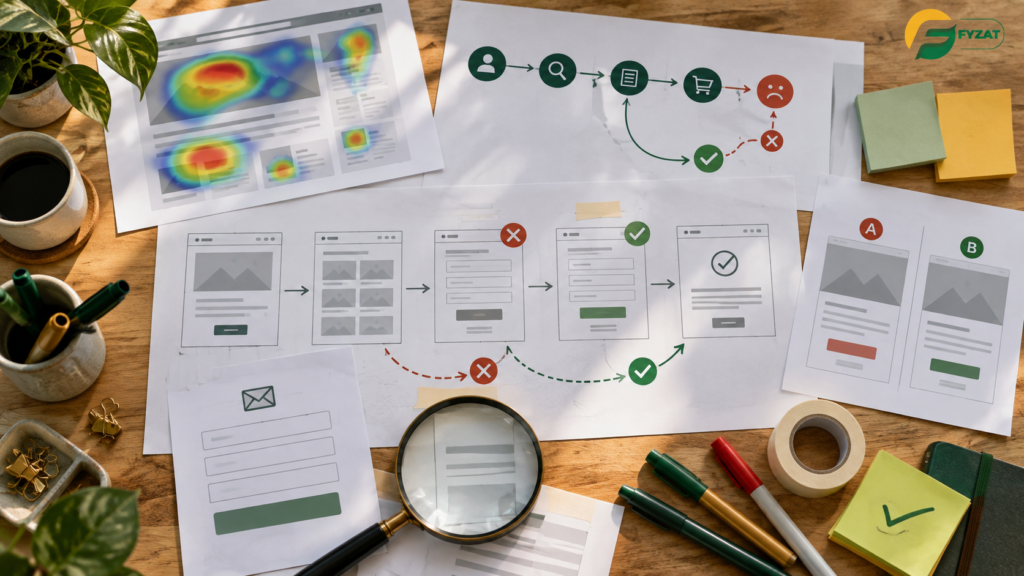
You cannot improve performance when you do not know which actions are happening or where visitors are leaving.

Problem 11: You Measure Traffic Instead of Meaningful Actions

Traffic is useful, but it is not usually the final business goal. Track the actions that matter to your organisation, such as:

In Google Analytics 4, important actions can be marked as key events. Test the setup to confirm that successful actions are recorded correctly. A website may appear to generate no leads when its tracking is incomplete or inaccurate.

Then identify which pages, search queries, campaigns, and channels contribute to meaningful enquiries. Compare both lead volume and lead quality. A large number of poor enquiries is not necessarily a successful result.

Problem 12: You Never Test or Improve Your Pages

Your first version of a landing page does not need to be the final version. Use real behaviour and conversion data to decide what needs attention.

You may improve or test:

Do not randomly change everything at once. Find the clearest problem, make a meaningful improvement, and measure what happens. Make sure you have enough reliable data before drawing conclusions from a test.

A Quick Website Lead Generation Checklist

If your website gets traffic but produces few enquiries, review these questions:

You do not need to fix every page at once. Start with high-traffic commercial pages and the issues most likely to prevent visitors from taking action.

Do not randomly change everything at once. Identify the biggest problem, make a meaningful improvement, and measure the result.

Final Words

If you are getting website traffic but no leads, more visitors may not solve the problem. First, check whether you are attracting the right people, matching search intent, explaining your offer clearly, building trust, and making the next step easy.

Fixing these issues can make your existing traffic more valuable and create a clearer journey from first visit to qualified enquiry.

Turn More Qualified Visitors Into Leads Fyzat helps businesses review the SEO, content, user experience, and conversion issues that may prevent visitors from taking action.

Frequently Asked Questions

Why is my website getting traffic but no leads?

Common causes include irrelevant traffic, poor search-intent matching, weak CTAs, unclear offers, low trust, poor mobile UX, complicated forms, and incorrect conversion tracking.

Not necessarily. Traffic quality and conversion performance matter. A smaller qualified audience can generate more business than a large irrelevant audience.

Review the search queries, landing pages, traffic sources, visitor behaviour, locations where relevant, and conversions. Determine whether visitors match the people likely to need your service.

A conversion is a meaningful action you want a visitor to complete, such as submitting a form, calling, booking a consultation, requesting a quote, registering, or purchasing.

There is no single good rate for every website. It varies by industry, traffic source, offer, device, business model, and conversion type. Compare performance against your own historical data and relevant business benchmarks.

Yes. SEO can attract potential customers when your keyword targeting, content, service pages, search intent, and conversion journey work together.

The keywords may be too informational, the page may not match user intent, the offer may be unclear, or the visitor may not have enough trust or motivation to take the next step.

Make the action specific and easy to understand. Explain what users get and what happens next. Place the CTA naturally at important decision points.

If unnecessary fields are creating friction, yes. Ask for the information needed to start the conversation and collect additional details later when appropriate.

Usually both. SEO can help attract qualified visitors, while conversion optimization helps turn more of those visitors into meaningful actions.

On this page

Getting Traffic but Not Enough Leads?

Request a professional website and SEO review to identify traffic-quality, content, user-experience, and conversion issues that may be limiting enquiries.

Swapna Begum

WRITTEN BY

Swapna Begum

Author at Fyzat. Stay tuned for more informative articles and updates from this author.

Scroll to Top